Overview
A synthetic dollar backed by real-world private credit and bonds.
Agama turns USDC into a yield-bearing position in curated real-world credit, without a fund subscription, a lock-up negotiation, or underwriting a single deal blind. Deposit USDC into the Vault, receive agUSD, stake it for sagUSD, and a Curator deploys the capital into vetted credit vaults under limits the contracts enforce.
The problem
Private credit and bonds pay real yield, but that yield sits behind slow, manual, fund-style access: subscription paperwork, minimum tickets, and settlement cycles measured in weeks. On-chain capital has no fast way in, and no way to spread across several deals without doing that paperwork many times over.
The other half of the problem is the one that gets less attention. Once capital is pooled, somebody has to decide where it goes, and in most structures that decision is a policy document. Agama makes it a contract call that can be refused.
Architecture in one picture
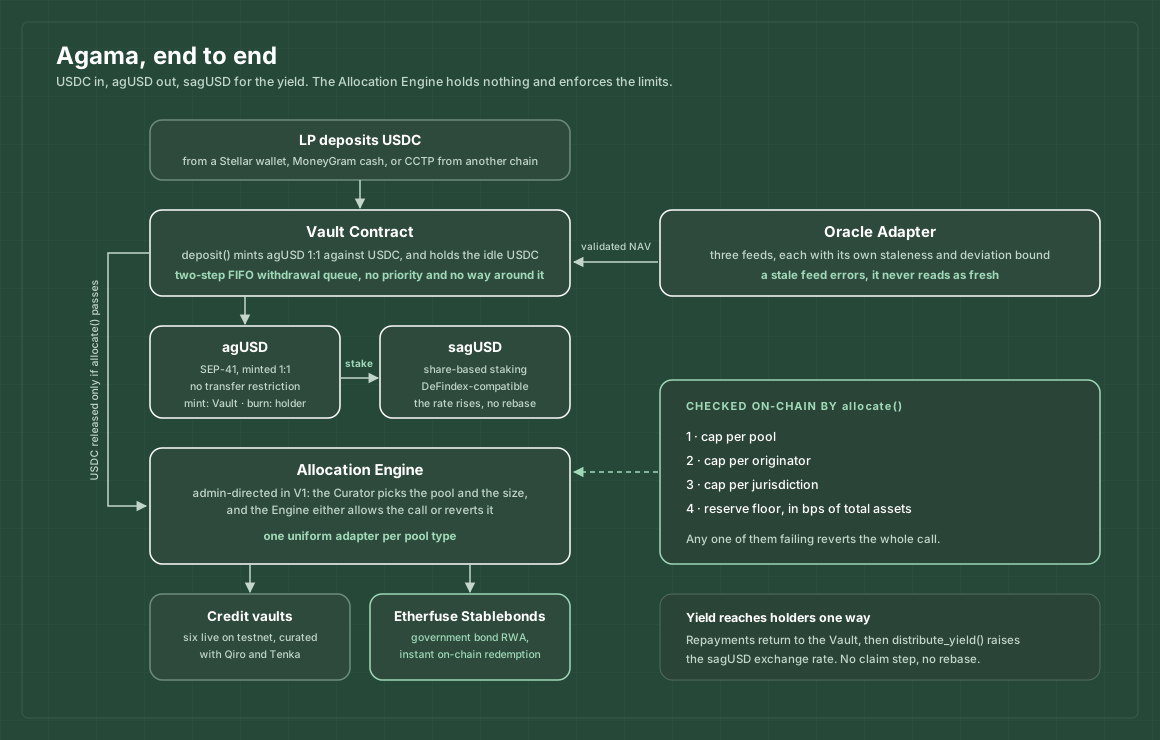
Components
The protocol has four parts.
-
Credit vaults. Six are live on Stellar Testnet, curated with Qiro and Tenka, each an independent Soroban contract with its own share token. They are where deposited capital earns: short-term payment receivables, diversified credit funds, institutional lender financing, asset-backed senior and mezzanine tranches. See Credit Vaults.
-
agUSD. A synthetic dollar. The Vault mints it 1:1 against USDC and is the only address allowed to mint it. Burning is the holder's own:
burnandburn_fromare the standard SEP-41 paths, and the Vault uses that same path when it burns a withdrawer's agUSD. Supply can only go up through the Vault, and down through anyone holding the token. It is a plain SEP-41 token with no transfer restriction, so other Soroban protocols can hold it and compose with it. agUSD on its own earns nothing. See agUSD. -
sagUSD. Stake agUSD and receive sagUSD shares at the current exchange rate. Yield arrives by raising that rate, not by changing balances, so there is no claim step and no rebase. See sagUSD.
-
The Allocation Engine. The contract between the Vault and the credit vaults. In V1 a Curator directs it: a person chooses the pool and the amount and calls
allocate(). What the Engine contributes is refusal. Every call is checked in the same transaction against a cap per pool, a cap per originator, a cap per jurisdiction, and a reserve floor, and any one of them failing reverts the whole call. The three caps are measured in basis points of net assets and the floor in basis points of net assets plus everything ever written off, so that recognising a loss cannot create room to deploy; the floor is 2500 bps on testnet. The Vault holds its own copy of the floor and applies it again when it releases the cash, because the Engine is only an address the Vault authorizes. See Soroban Contracts.
What the contracts enforce, rather than the policy
Some properties are worth stating precisely, because each is a line of Rust rather than a commitment.
| Property | How it is enforced |
|---|---|
| No single pool, originator or jurisdiction takes the book | allocate() measures the resulting exposure against net assets and reverts on a breach |
| Fast-exit liquidity scales with the book | The reserve floor: an allocation reverts if the call would leave the Vault holding less free USDC than floor_bps of floor_base, 2500 bps on testnet, checked by the Engine and again by the Vault |
| Recognising a credit loss cannot release capital | Written-off exposure stays in the floor's denominator permanently, so a write-down moves the book and does not move the limit |
| A queued withdrawal cannot be lent out | Queued claims are tracked on-chain and subtracted from free reserves and net assets before any limit is computed |
| A queue cannot be stalled | settle_withdrawal() is permissionless and pays the head claim to its recorded owner |
| A queue cannot be frozen | A claim the USDC contract refuses to deliver is deferred and stepped over, unpaid and still owed, rather than trapping the payout |
| The withdrawal queue cannot be reordered | Claims are paid strictly in request order, and there is no admin path around it |
An Engine that has been deployed but not configured cannot deploy capital at all: every cap starts at zero and the reserve floor starts at 10000 bps, which is 100%. Opening it up is an explicit admin action that emits an event.
Where the yield comes from
The return is paid by real-world borrowers, private credit obligors and bond issuers, not by protocol emissions or by other depositors. Repayments settle off-chain through banking rails, come back on-chain as USDC, return to the Vault, and reach holders as a higher sagUSD exchange rate. That off-chain leg is the part of the system that carries the most trust, and it is documented in full in Settlement & NAV and Risks.
Getting started
- New here: How It Works walks the full path, from cash to a yield-bearing position and back out.
- Looking at the credit side: Credit Vaults.
- Looking at the tokens: agUSD and sagUSD.
- Looking at the contracts: Soroban Contracts and Deployments.